Skip to content
On Little Bighorn’s 150th anniversary, a rancher sees the same fight over land
Photo: Kim Monson Newsroom

On Little Bighorn’s 150th anniversary, a rancher sees the same fight over land

On the sesquicentennial of the battle the Lakota call the Greasy Grass, rancher Trent Loos told The Kim Monson Show that the same pattern is pressuring Western landowners today: government taking land it once promised, now for wind, solar, and high-voltage transmission lines.

Kim Monson Newsroom June 24, 2026
Listen to this article
0:00 / 0:00
Hooters of Colorado Wings, Beer & Good Times Learn More →

The Kim Monson Community

Members get a front-row seat.

Live town halls with Kim’s guests are open to every member; classes are included with Monticello & Mount Vernon membership.

The Federalist Papers · Class 10

Federal Government and Taxes, Part 2

Part two on federal taxation: how state and federal taxing powers coexist, and the objections the Federalist answers.

with Allen Thomas · Instructor

Thursday, July 2 · 7:45 PM · Online

Monticello & Mount Vernon members

One hundred fifty years after the Battle of the Little Bighorn, Trent Loos, a sixth-generation Nebraska rancher and broadcaster, told The Kim Monson Show that the fight which ended in that valley is the same one his neighbors are living through today. “It’s about land. It’s about gold. It’s about deals that are made that are now reneged on,” Loos said.

The battle was fought June 25, 1876, near the Little Bighorn River in Montana Territory, where Lt. Col. George Armstrong Custer and his 7th Cavalry were overwhelmed by Lakota Sioux and Cheyenne warriors led by Sitting Bull and Crazy Horse. The Lakota call it the Battle of the Greasy Grass, a name drawn from the lush valley grasslands that were often slick with dew. Loos said few Americans remember what set it in motion.

A promise, then gold

The cause, he argued, was a guarantee broken for profit. The 1868 Treaty of Fort Laramie set the Black Hills and the surrounding territory apart for the “absolute and undisturbed use and occupation” of the Sioux. Six years later an Army expedition confirmed gold in the Black Hills, prospectors poured in, and the federal government moved to take back the land it had pledged. “The government, the federal government, signed treaties with the Indian tribes, and then gold is discovered in the Black Hills,” Loos said.

Loos traced the same pattern through Colorado. Twelve years before the Little Bighorn, on Nov. 29, 1864, a peaceful Cheyenne and Arapaho camp led by Black Kettle was attacked at Sand Creek in southeastern Colorado Territory, in what is now Kiowa County near Eads. The Sand Creek Massacre was carried out by roughly 675 troops, chiefly the Third Colorado Cavalry, a volunteer regiment under Col. John Chivington. An estimated 150 to 230 people were killed, more than half of them women, children, and the elderly, even as an American flag and a white flag flew over the camp.

The timing of statehood

Loos sees the timing of Colorado’s own statehood as part of the same arc. Congress had tried to admit Colorado before, but President Andrew Johnson vetoed the bids in 1866 and again in 1867, calling the territory’s population, officially counted at fewer than 28,000, “entirely too small either to assume the responsibilities or to enjoy the privileges of a State.” Colorado was finally admitted to the Union on Aug. 1, 1876, about five weeks after the Little Bighorn.

The same fight, new names

For Loos, the through line to the present is direct. “And this is 100% government manipulating people to take land,” he said. Kim Monson tied it to the build-out reshaping rural Colorado: “Well, we are seeing that with the industrial complex going on with wind projects, solar projects, transmission projects.”

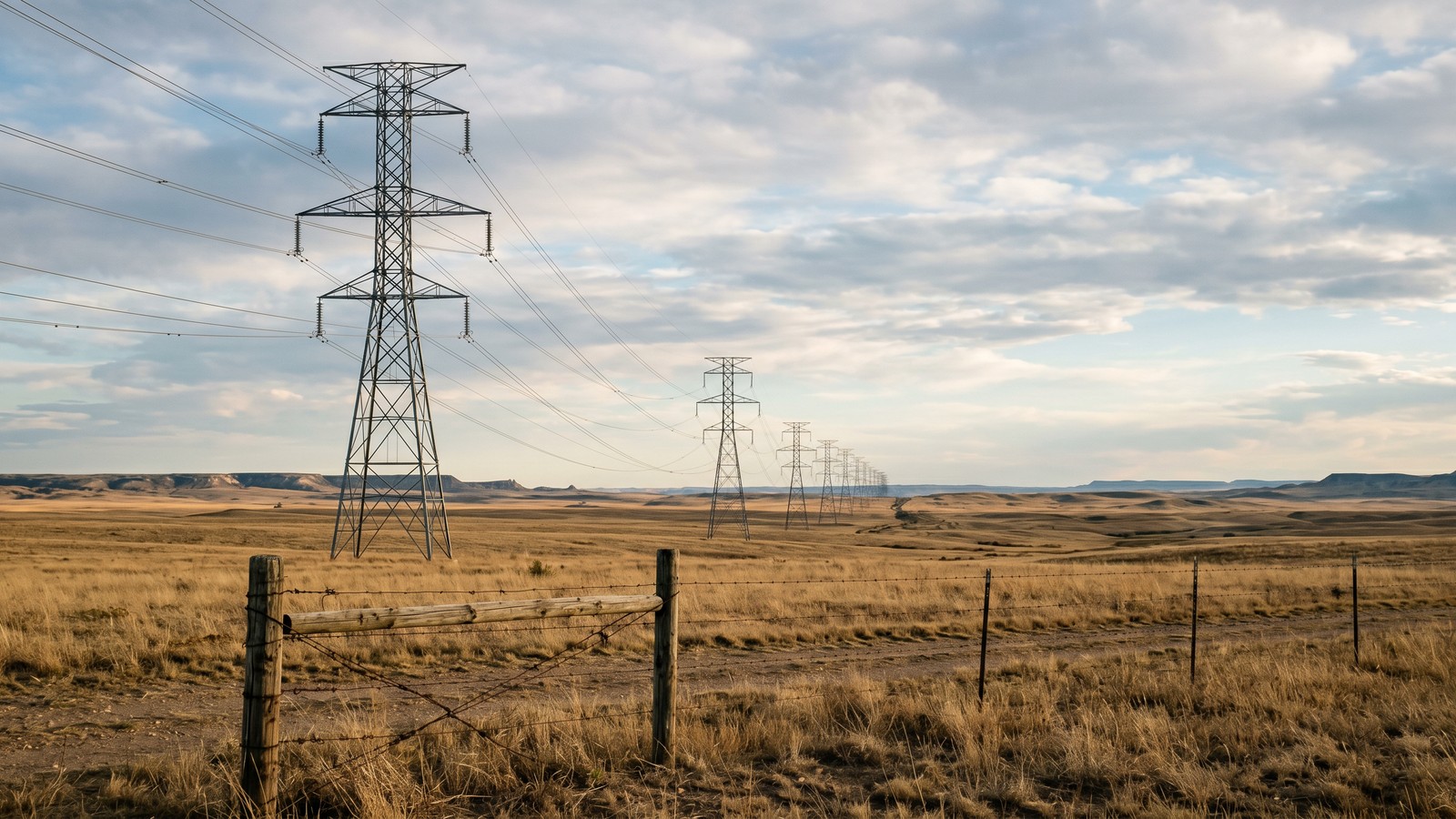
The examples are not hard to find. In Elbert County, Xcel Energy is using eminent domain to clear a route for its 550-mile Colorado Power Pathway, a $1.7 billion transmission line built to carry Eastern Plains wind and solar to the Front Range. The Colorado Sun reported that the utility needs rights of way across 48 properties and has filed for court-ordered entry on 13 where landowners refused. “We have property rights, until we don’t,” rancher Don Gray told the Sun.

The pressure reaches the same southeastern counties that hold the Sand Creek site. A proposed federal National Interest Electric Transmission Corridor would run through Baca, Prowers, and Kiowa counties, and residents there fear it amounts to federal eminent domain. The Colorado Sun reported that dozens gathered at the Prowers County Courthouse in February to oppose it. “The prosperity that hardworking people have spent their lives working for will be taken from them with the swipe of a pen,” rancher Dallas May said.

Loos says the pattern is bigger than any one project or state. “It’s happening in every state in this nation. It’s happening at the federal level,” he said. The technology has changed since 1876, and so have the names on the maps. The questions he hears underneath them, he said, are the same ones raised at the Greasy Grass: who decides what happens to the land, and what a promise about it is worth.

Support independent journalism

The reporting in this article draws on the work of 1 independent newsrooms. Local and state journalism is shrinking across the country. Subscribing, donating, or becoming a member is the most direct way to keep these outlets covering the stories that matter to Colorado.

Kim Monson Independent voice for liberty, free markets, Colorado, and America
Sources cited in this article

Member Discussion

What Members Are Saying

No comments yet. Be the first to share your thoughts.

Join the Discussion

Support Independent Journalism

Membership starts at $50/year. Three tiers of access to Kim, community, and exclusive content.