Skip to content
Natelson walks Coloradans through the Declaration of Independence as it turns 250
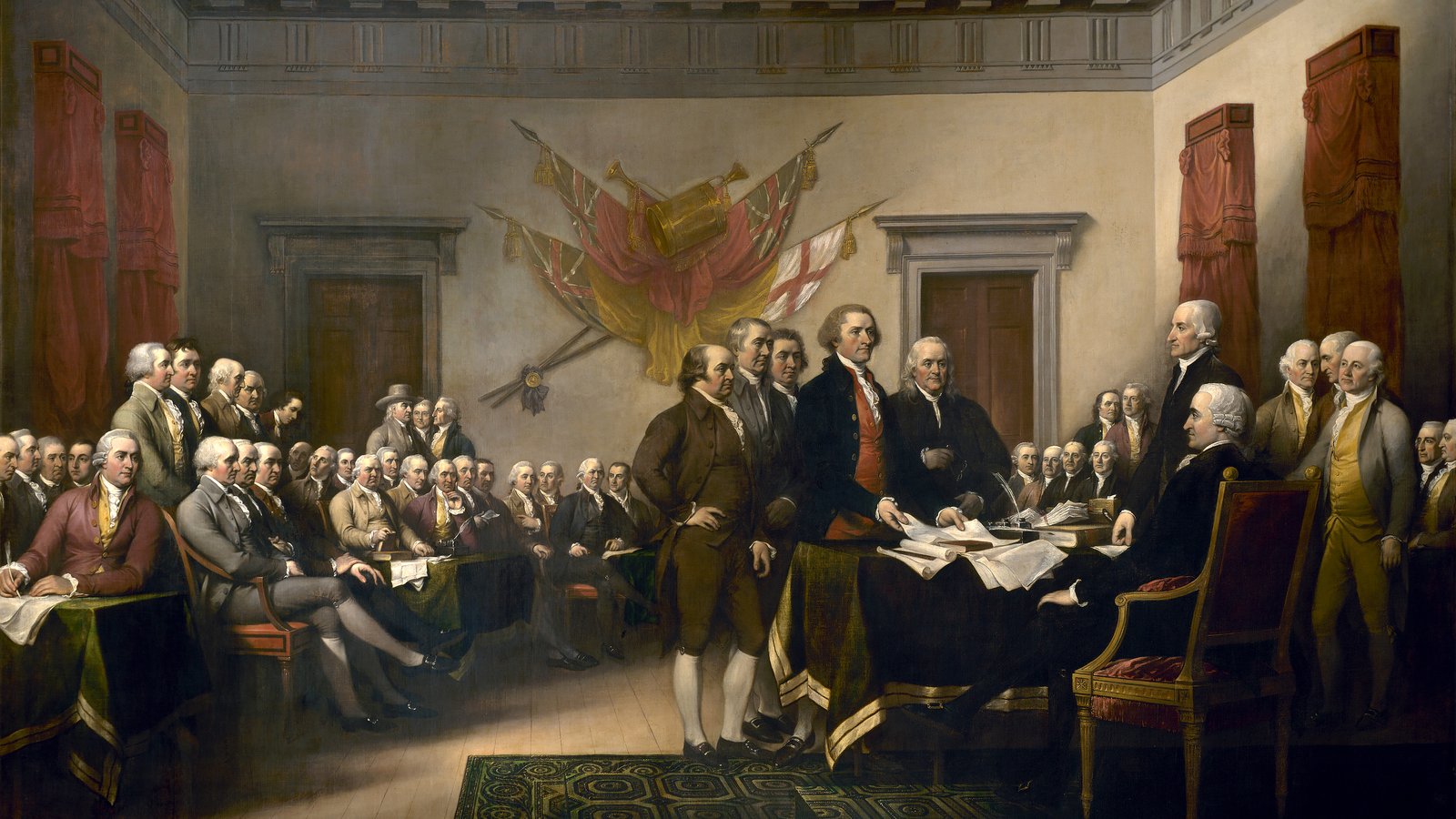
Photo: John Trumbull, 'Declaration of Independence' (1818), public domain via Wikimedia Commons

Natelson walks Coloradans through the Declaration of Independence as it turns 250

Constitutional scholar Rob Natelson walks through his six-part essay series on the Declaration of Independence, from the run-up to revolution to the document's place among the most important political texts in Western history.

Kim Monson Newsroom June 9, 2026
Listen to this article
0:00 / 0:00
Excalibur Classical Academy Classical Christian K-3, Centennial Enroll →

The Kim Monson Community

Members get a front-row seat.

Live town halls with Kim’s guests are open to every member; classes are included with Monticello & Mount Vernon membership.

The Federalist Papers · Class 10

Federal Government and Taxes, Part 2

Part two on federal taxation: how state and federal taxing powers coexist, and the objections the Federalist answers.

with Allen Thomas · Instructor

Thursday, July 2 · 7:45 PM · Online

Monticello & Mount Vernon members

The Declaration of Independence turns 250 this year, and constitutional scholar Rob Natelson used the milestone to revisit how the document came to be, why some founders feared its timing, and why it still shapes American argument today. Natelson, a scholar at the Mountain States Policy Center and Colorado’s Independence Institute, joined The Kim Monson Show to walk through a six-part series he published as op-eds in The Epoch Times, with free versions on the Mountain States Policy Center website. He is the author of The Original Constitution: What It Actually Said and Meant.

Each installment takes a slice of the story: the events that led to the break with Britain, the founder who argued the timing was wrong, the committee that drafted the text, the document’s structure, its debt to history, and its legacy.

How a happy empire soured into revolution

Natelson opened the first installment with a fact he says schools tend to skip. North American colonists were, on the whole, contented British subjects until about 1763. They prized the rights of Englishmen and enjoyed a wide measure of self-government. Before that year, he explained, the British Empire ran less like a unified state and more like a federation. London handled foreign affairs, regulated trade among the empire’s units, and ran the imperial post office, while the thirteen colonies imposed their own taxes and made their own local law through their assemblies.

That balance collapsed after the French and Indian War, when the British ministry began restricting westward migration, levying new taxes such as the stamp tax and the Townshend duties, regulating manufacturing, and meddling with colonial currency. The colonists protested, petitioned, and held conventions; armed resistance broke out in 1775 and ran for roughly fourteen months before independence was declared. Natelson drew the parallel to the present directly. “A federation where the central authority is growing relentlessly and always grabbing for more power,” Natelson said, prefacing the line with a note that the dynamic should sound familiar.

The patriot who said July 1776 was too soon

Not every leader wanted to declare independence in the summer of 1776, and Natelson devoted his second installment to the most prominent dissenter. “And then there were those people like the great John Dickinson, one of the foremost founders who recognized that independence might be necessary down the road, but thought that issuing the declaration in July of 1776 was premature and might cause more problems than it solved,” Natelson told Kim Monson. On July 1, 1776, Dickinson argued against the timing in a celebrated Continental Congress debate with John Adams, and Adams prevailed.

Natelson was careful to defend Dickinson’s character as a patriot who doubted only the timing. Dickinson stayed committed to the American cause, and “after he lost that vote, he actually enlisted in the army to help fight the British,” Natelson said. Dickinson worried that the colonies should first secure a French alliance and the means to sustain a long war; when the vote went against him, he stayed away so the decision could be unanimous, then resigned from Congress to join the Continental Army. He had also chaired the committee that drafted the Articles of Confederation. Dickinson’s caution, in Natelson’s telling, was the prudence of a patriot, and parts of it proved prophetic as the war dragged on at great cost.

The Committee of Five and the men behind the text

Thomas Jefferson is remembered as the author of the Declaration, and Natelson agreed that the popular memory is largely right. “Most people think of Thomas Jefferson as writing the Declaration of Independence, and that’s true. He produced the first draft. He wrote most of it. But he was one of a committee, which historians call the Committee of Five,” Natelson said. The Continental Congress appointed that committee on June 11, 1776. Alongside Jefferson sat John Adams, Roger Sherman, Benjamin Franklin, and Robert R. Livingston. Natelson noted that Livingston is the least known of the group yet among the most consequential, since he helped launch the first steamboats on the Hudson River early in the next century.

Sherman drew special attention for a record few can match. “He signed the Declaration of the Causes for taking up arms. He signed the Constitution. He signed the Articles of Confederation. Roger Sherman was involved in virtually every significant, important step in the founding era,” Natelson said. Natelson’s third installment also returns to Adams. As president, in Natelson’s account, he made decisions that rendered him deeply unpopular, cost him re-election, and were eventually vindicated. The chief example was foreign policy. During the Quasi-War with France from 1798 to 1800, with Federalists led by Alexander Hamilton agitating for a full war, President Adams sent diplomats to Paris and reached a negotiated settlement that kept the peace. Natelson called it probably Adams’s greatest achievement as president, a peace that bought the young country time to grow even as it angered his own party and helped cost him the election of 1800.

A conservative revolution and a debt to English law

For all its violence, Natelson argued, the American Revolution preserved far more than it discarded. “The American Revolution was violent. But it’s also been described as a conservative revolution because we decided to keep the institutions that we had had under the English. So we kept, for example, Anglo-American law. We still use Anglo-American law today. Colorado and most states have statutes that explicitly import into our law the common law of England,” Natelson said. That continuity runs deep into the Constitution itself; the Eighth Amendment draws its bar on cruel and unusual punishments almost word for word from the English Bill of Rights of 1689.

Membership
Keep Independent Voices on the Air
Kim buys her own airtime to keep this conversation honest. Your membership funds independent journalism that holds Colorado leaders accountable.

The fourth and fifth installments walk through how the Declaration of Independence is organized and where its ideas came from, tracing its line of descent from older English and European sources. The continuity Natelson described is why, in his account, the founders could break from the Crown while keeping the legal inheritance that made self-government workable.

Saratoga, Lincoln, and a place among four documents

The Declaration was meant in part to win foreign allies, but that payoff was slow. “It took the Battle of Saratoga for the French to help us,” Natelson said of the sixth installment. The American victory at Saratoga in 1777 finally persuaded France to commit, and the Treaty of Alliance followed in 1778, more than a year after independence was declared. The document’s deeper legacy, Natelson said, lay in the ideas it planted. “And I give as an example of that Abraham Lincoln’s references to the Declaration of Independence, to the idea that all men are created equal, as an indictment of slavery,” he said.

Natelson closed with a ranking that placed the Declaration in rare company. “And I point out that ultimately the Declaration of Independence proved to be one of the four most important secular political documents in Western history,” he said. The four, in his account: “Magna Carta, the Code of the Emperor Justinian, which became the basis for law throughout all of Europe, are the United States Constitution and the Declaration of Independence.” Natelson brings rare standing to that comparison; he co-edited the first complete online edition of the Emperor Justinian’s Roman law collection, one of the very texts he names. He ranks the Declaration among them as a scholar’s judgment about which documents most shaped the Western political tradition.

Support independent journalism

The reporting in this article draws on the work of 1 independent newsrooms. Local and state journalism is shrinking across the country. Subscribing, donating, or becoming a member is the most direct way to keep these outlets covering the stories that matter to Colorado.

Kim Monson Independent voice for liberty, free markets, Colorado, and America
Sources cited in this article

Member Discussion

What Members Are Saying

No comments yet. Be the first to share your thoughts.

Thread: Declaration of Independence at 250